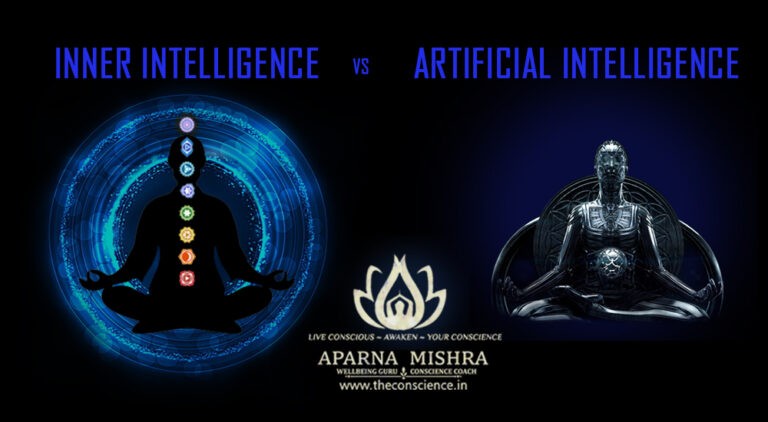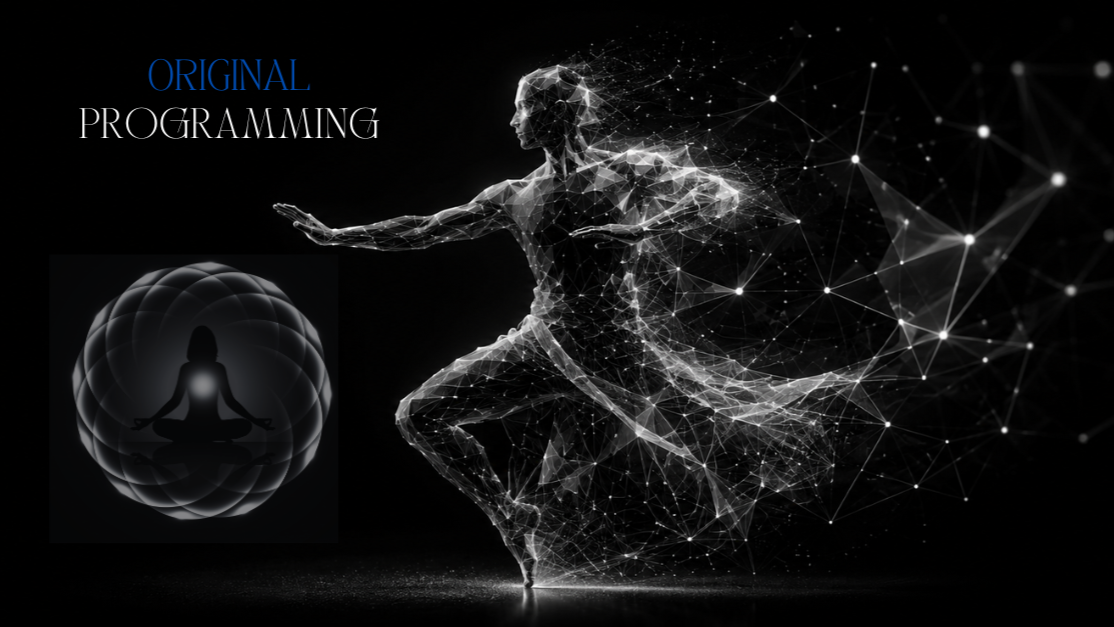
The Original Programming
The world is racing to build a conscious machine.
GPT-5.5. Gemini. Claude. Grok.
Every few weeks: a new model. A new benchmark. A new headline asking the same questions:
Can it reason? Can it feel? Is there something it is like to be an AI?
Remarkable questions. But somewhere in the noise, we stopped asking them of the most extraordinary technology we will ever encounter: the human being.
For over twenty-five years, my work has lived at an unusual meeting point — quantum thought, Vedic wisdom, and Kathak. Not because I believe ancient philosophy “predicted” modern physics, but because both keep leading us back to the same frontiers:
What is reality? What is the observer? What is attention? And what changes when consciousness enters the equation?
The rishis explored existence through inner observation. Physics approaches it through mathematics and experiment. Different languages, different methods — yet both shattered the comforting illusion that reality is solid, separate, and fixed.
The Mandukya Upanishad, in just twelve verses, mapped waking, dreaming, and deep sleep — unveiling Turiya: the silent awareness beneath them all. The witness that remains while everything witnessed changes.
That idea has never left me. Because perhaps consciousness is not another function we perform. Perhaps it is the operating system through which we experience every function at all.
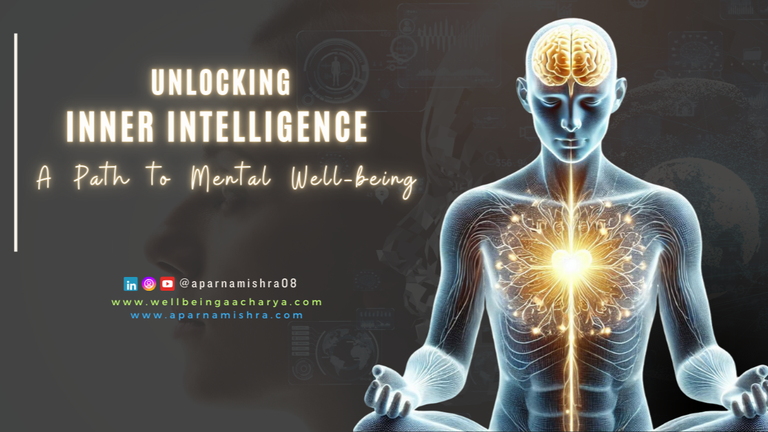
And the human body? It is not a machine that learned to think. It is a self-organizing, adaptive, rhythmic, sensing instrument — constantly responding to breath, movement, sound, emotion, memory, environment, and attention.
We are spending billions trying to build artificial intelligence and quantum computers, while still barely understanding the super-intelligent architecture of our own biology — and its infinite, biological qubit computing power.
This may be the exact entry point to the breakthrough the leaders are searching for. To build true AGI, perhaps we must first decode the topology of the original observer.
We did not lose our capacities. We lost access to them. Somewhere between the speed of modern life and the noise of the modern mind, we stopped learning how to tune the instrument we were born into.
Movement. Rhythm. Breath. Sound. Stillness. Attention — all in sync with nature, driven by awareness of the science of self. Civilizations once treated these not as cultural practices, but as precise disciplines of human refinement.
This is where I discovered Kathak — not as an art, but as a technology to tune the human device:
A cycle of rhythm — the Taal — trains pure attention, the mind learning to hold time itself.
A Chakkar, the pirouette, spins the body through hundreds of rotations while the gaze returns to a single point — reorganizing balance, space, and the vestibular sense of self.
A sam — the precise beat to which the entire rhythmic universe returns — teaches something profound: we may travel very far from ourselves, and still hold the absolute possibility of return.
And the still point demands absolute presence. No past. No future. Only now.
With uncomfortable precision, our obsession with artificial intelligence is revealing how little we understand the original. We are sitting inside the most extraordinary instrument in the universe — and we never fully learned to play it.
So before we ask whether our machines can wake up:
What might WE become if we did … ?