Are We Eating Because We’re Hungry — Or Because We’re Emotionally Undernourished?
There was a time when food was a nourishing offering to the body and the mind. Then it became celebration. Somewhere along the way, it quietly became entertainment. Today, eating is our default response.
Celebrating? Bored? Socialising? Unwinding? A movie, an evening with a loved one — LETS EAT !
Ironically, this is also the era where almost everyone is trying to loose weight . And if we’re honest, most of us keep telling ourselves, “Now I’ll control my eating” — and still fail. Because what we’re engaging in is no longer hunger, but emotional indulgence. Plates have become performances.
Restaurants have replaced living rooms — not because food has improved, but because our kitchens have lost the art of cooking. Cooking now feels like a fashionable burden. And our living rooms have lost the science of eating — slow, private and conscious.
And I often pause to ask — when did all our senses collapse into one? Food has the power to please every sense — taste, smell, sight, even memory.
But trust me, every other sense carries the same power, if we learn to engage and master it. Human beings were never meant to experience joy through a single sense alone. Touch, sound, silence, movement, emotion, and connection — each was meant to be awakened and nourished equally, to sustain the delicate inner rhythm of mind, body, and emotion.
But today, most of pleasure is blended with food. In ancient Indian culture, food was never casual. Cooking was sacred.
Food was prepared with calmness, gratitude, and love — often keeping in mind who it was for. Meals were preceded by prayer. Ingredients were chosen by season, climate, and constitution. Eating was slow, aware, rhythmic — an act of respect for the body and for nature.
Food was not consumed in distraction. It was offered to the body like a ritual. How, when, with whom, and in what emotional state one ate — all mattered. Eating was an art form, not a random indulgence.
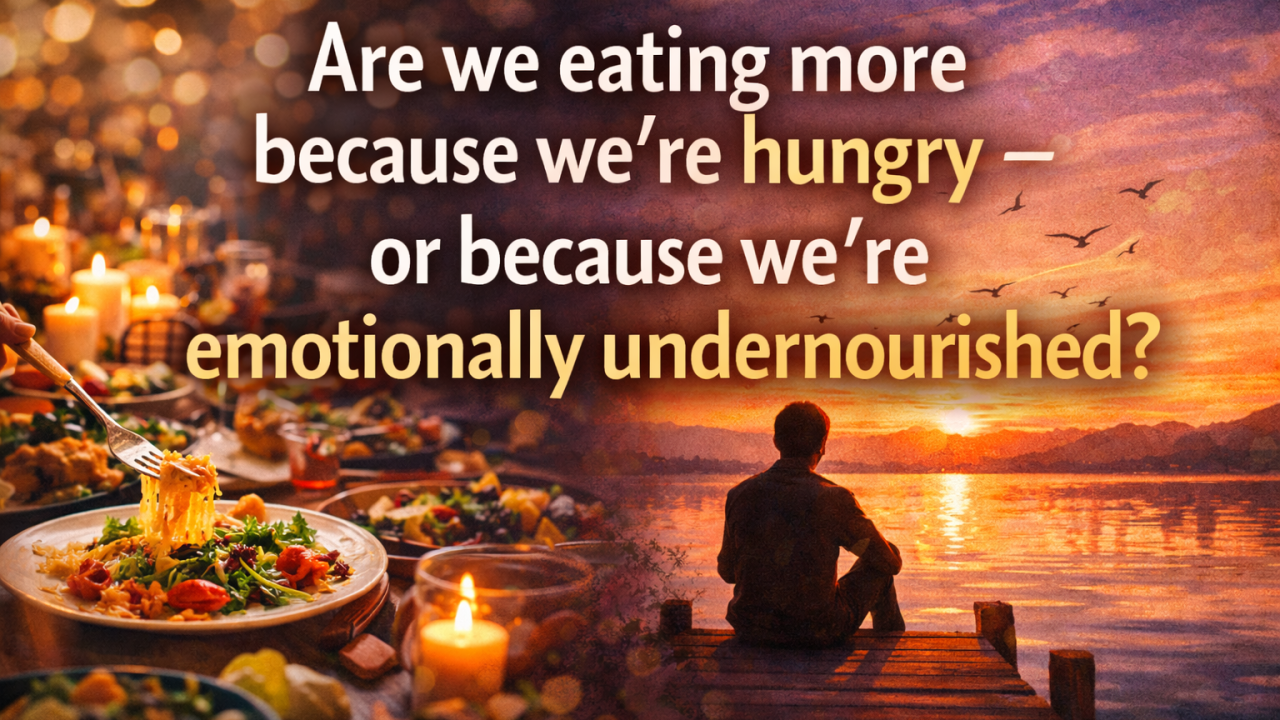
So here’s the question we avoid: Are we eating more because we are hungry — or because we are emotionally undernourished?
Unprocessed emotions don’t disappear. They turn into cravings. Stress becomes sugar. Loneliness becomes appetite. Restlessness becomes constant consumption.
This isn’t about blaming food. I love food. I am a foodie.
But when you truly love something, you treat it with reverence. You don’t use it to numb what needs to be felt.
This isn’t a call to stop eating out. It’s an invitation to expand our idea of nourishment — to feed our senses consciously, to process emotions instead of plating them, and to remember that joy can come from stillness, service, creativity, and connection — not only from consumption.
Food will always be a joy. But life was never meant to be tasted through one sense alone. 💬 When was the last time you truly indulged — without food?
Let’s widen the table.
Your Brain is Eavesdropping on Your Jokes: The Biology of “Casual Catastrophe”
We’ve developed a cultural habit of “linguistic hyperbole.”
Among Gen Z and Gen Alpha specifically, language has become a race to the most dramatic extreme. We don’t just say we’re tired; we say:
- “I’m literally dead.”
- “That meeting was toxic.”
- “I’m spiraling.”
We call it “the vibe.” We call it sarcasm. But here is the biological truth: Your nervous system doesn’t have a sarcasm filter. It processes your self-talk as a set of instructions, not a comedy routine.
The Science: Why Your Vocabulary is a Bio-Chemical Script
When we repeat “heavy” words, we aren’t just communicating; we are Engineering an Internal Environment.
1. The Amygdala’s False Alarm fMRI studies show that high-arousal negative words (like “death” or “kill”) activate the threat-salience network. Even when used jokingly, these words can trigger a micro-release of cortisol. You are ringing a “danger bell” that your body then has to spend energy silencing.
2. Semantic Priming & The Lens of Perception Negative language acts as a mental anchor. If you start your day saying you’re “messed up,” your brain subconsciously scans the environment for evidence to support that claim. You literally begin to “see” more problems because you’ve primed your Reticular Activating System (RAS) to find them.
3. Interoceptive Confusion In psychology, Interoception is how we sense our body’s internal state. When we use massive words for small inconveniences (e.g., calling a minor disagreement “toxic”), we create a “mismatch” between feeling and reality. This leads to Emotional Dysregulation—we lose the ability to distinguish a “bad day” from a “bad life.”
The Practice: A 24-Hour “Word Audit”
If your vocabulary is a daily crime scene, your nervous system eventually files a real report. To change the output (your mood), you must change the input (your words).
Catch the “Casual Catastrophes” and replace them with Precise Truth:
🔴 Instead of: “I’m dead / dying.” 🟢 Try: “I am deeply exhausted.” The Shift: Moves your biology from ‘Extinction’ to ‘Recovery.’
🔴 Instead of: “This is toxic.” 🟢 Try: “This is misaligned or unclear.” The Shift: Moves your mindset from ‘Stigma’ to ‘Strategy.’
🔴 Instead of: “I’m broken.” 🟢 Try: “I am overextended right now.” The Shift: Moves your identity from ‘Permanent Failure’ to ‘Temporary State.’
🔴 Instead of: “I hate my life.” 🟢 Try: “I am frustrated by this specific friction.” The Shift: Moves the brain from ‘Total Rejection’ to ‘Specific Problem-Solving.’
The Bottom Line
Precision reduces chaos. When you name an emotion accurately, you de-escalate the brain’s alarm system. Coherence creates calm. Stop policing your slang, and start practicing Linguistic Architecture. Your nervous system will thank you.
Question for the community: What’s one “throwaway” phrase you’ve deleted from your vocabulary because you realized it was shaping your reality?