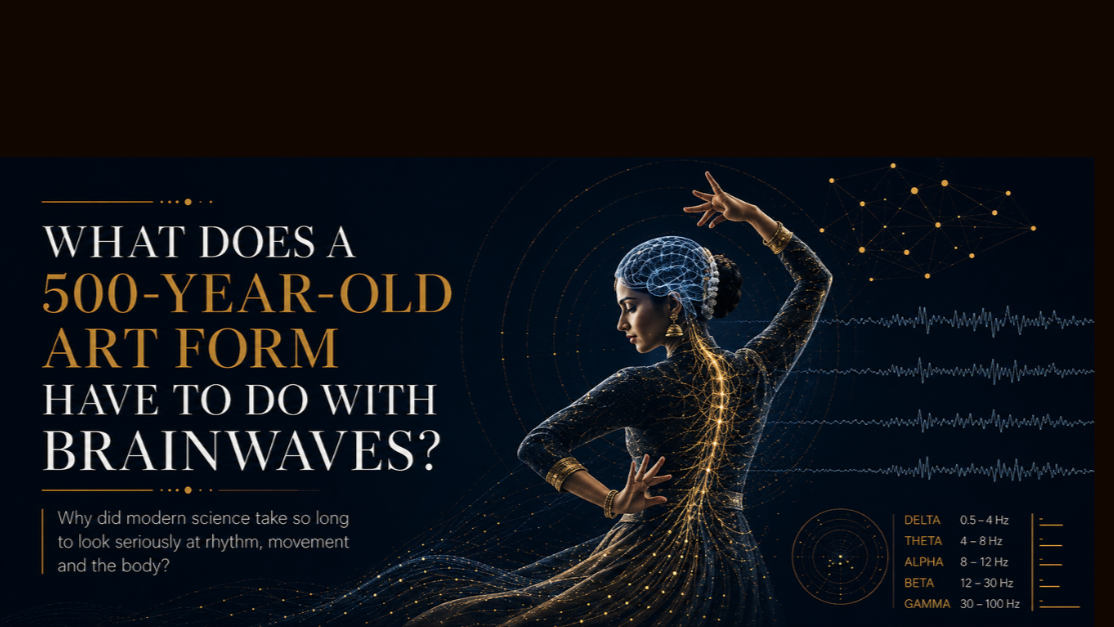
What does a 500-year-old Art form have to do with Brainwaves?
Better question: why did modern science take so long to look seriously at rhythm, movement and the body?
We studied the brain as if it lived alone. As if intelligence happened inside the skull, and the body simply carried it around.
A human being thinks with breath, posture, rhythm, tension. Emotion arrives before language. The nervous system speaks before the mind finds words.
A patient says “I am anxious” only after the breath has already changed, the jaw has already tightened, the pulse has already shifted.
The body reports. The intellect explains afterwards.
This is why I read Kathak as a sophisticated study of the embodied human system.
Kathak stands on its own. Neuroscience may need movement traditions to widen what it looks at.
Watch a dancer and you are watching timing, attention, balance, emotion, memory, breath, gaze, spatial intelligence and motor precision, managed simultaneously.
That is living neural architecture in motion.
In Kathak, rhythm is a command system.
Laya — tempo — changes the state of the body. Slow it and attention settles. Quicken it and energy mobilises. Move between the two and the system learns to change state while holding centre.
Medicine calls this regulation. Kathak calls it returning to rhythm. Same intelligence, different vocabulary.
This is where my work with frequency, brainwave states, music and movement becomes precise.
Every human being opens through a different door.
Even in EEG research, individual alpha peak frequency varies from person to person. It is studied as a relatively stable neurophysiological trait, with evidence of heritability. In simple language: your nervous system has its own signature.
I observed this in bodies for years before I found the scientific language for it.
Some people arrive with such high internal charge that deep work cannot begin immediately. Their system first needs to move towards an alpha-like state — broadly around 8 to 13 Hz — where the person is relaxed but awake, calmer but not collapsed, receptive but still alert.
If you take such a person directly into stillness, the body may resist. Or worse, the mind may perform calmness while the nervous system remains guarded.
Some people open more naturally in a theta-like state — broadly around 4 to 8 Hz — where the system becomes slower, more inward, and closer to imagery, memory, emotion and subconscious material. But theta must be spoken about with honesty. The same frequency band can appear in different states: drowsiness, meditation, inward attention, memory retrieval. Anyone selling one clean meaning for theta is oversimplifying the brain.
And then there are people who need a sharper gamma-like intensity — above 30 Hz — not for relaxation, but for integration. That state where scattered things suddenly bind into one coherent perception. Insight has a different electricity.
So the work is never to force a person into one “ideal” brainwave.
The work is to explore the doorway through which that particular nervous system becomes most receptive.
Through frequency, music, breath, rhythm, movement and stillness, I guide the student or client towards that state — not sleepy, not defensive, not performative, but deeply available.
Available enough for us to begin accessing the subconscious layers of the mind.
And that is where the real work begins.
Not at the surface level of thought, but at the level where the pattern was written.
The conscious mind explains. The subconscious mind runs the pattern.
If insight alone were enough, every therapist would be out of work by now.
The subconscious is the deeper operating system of a human being. Memory, fear, desire, belief, emotional patterning, intuition, conscience, identity — writing the script long before the conscious mind edits the dialogue.
There are layers below the ones I can name scientifically with confidence. Every serious inner tradition has spoken of material that sits deeper than ordinary memory. I have my own beliefs about those layers, but I will not smuggle them into a paragraph on frequency bands and call it science.
What I will say is this: rhythm, breath, music, movement and stillness can soften the guard at the surface. And when the guard softens, we sometimes arrive at the place where the pattern was formed.
That is when transformation stops being motivational language.
It becomes inner reprogramming.
Modern medicine and ancient practice need a more mature conversation here. A serious one.
The body has always produced data. We simply trusted the kind that machines could capture.
But some intelligence was preserved differently — in practice, repetition, correction, transmission, and in what a body could do again and again, generation after generation, without collapsing.
A mudra is not “just a hand gesture.” It is fine-motor precision held under full-body demand.
A chakkar is not “just a turn.” It is vestibular intelligence, balance, orientation and surrender to momentum.
A still point is not “just a pose.” It is the nervous system learning not to leak energy.
Expression is not “just emotion.” It is emotional precision made visible.
The dancer is constantly doing what the high-performance world now wants from every mind: staying alert without becoming anxious, responsive without becoming reactive, expressive without losing control, centred while moving through speed.
That is not art alone.
That is training.
And perhaps this is the missing bridge
We have built extraordinary technologies that read the body. But we have not spent enough time understanding practices that train the body to read itself.
The brain is not a king sitting above the body. It is part of an orchestra. Breath, heart rhythm, movement, emotion, memory and attention are all playing together — sometimes in harmony, sometimes in chaos. Attention conducts the whole thing, beautifully or badly, depending on how trained the human being is.
This is the science I am interested in. Kathak keeps its own authority. Ancient wisdom keeps its own language. And a more powerful question opens:
What happens to a human being trained through rhythm, breath, movement, emotion and awareness for years?
What changes in attention? In emotional regulation? In resilience? In decision-making? In the ability to return to centre?
Natya Yoga® emerged for me here. A way of studying the physics of the self.
Because the body is not only where disease appears. It is also where recovery can begin.
The body is not only where trauma is stored. It is also where rhythm can reorganise it.
The body is not merely an object of diagnosis. It is an instrument of intelligence.
The body is the access point. Breath is the password. Rhythm is the bridge. Movement is the language. Awareness decides what can be rewritten.
So to the doctors, neuroscientists, psychologists, therapists and researchers reading this — my question is simple.
What if some of the future of neuroscience is not hidden in the brain alone — but in the trained, rhythmic, conscious body?