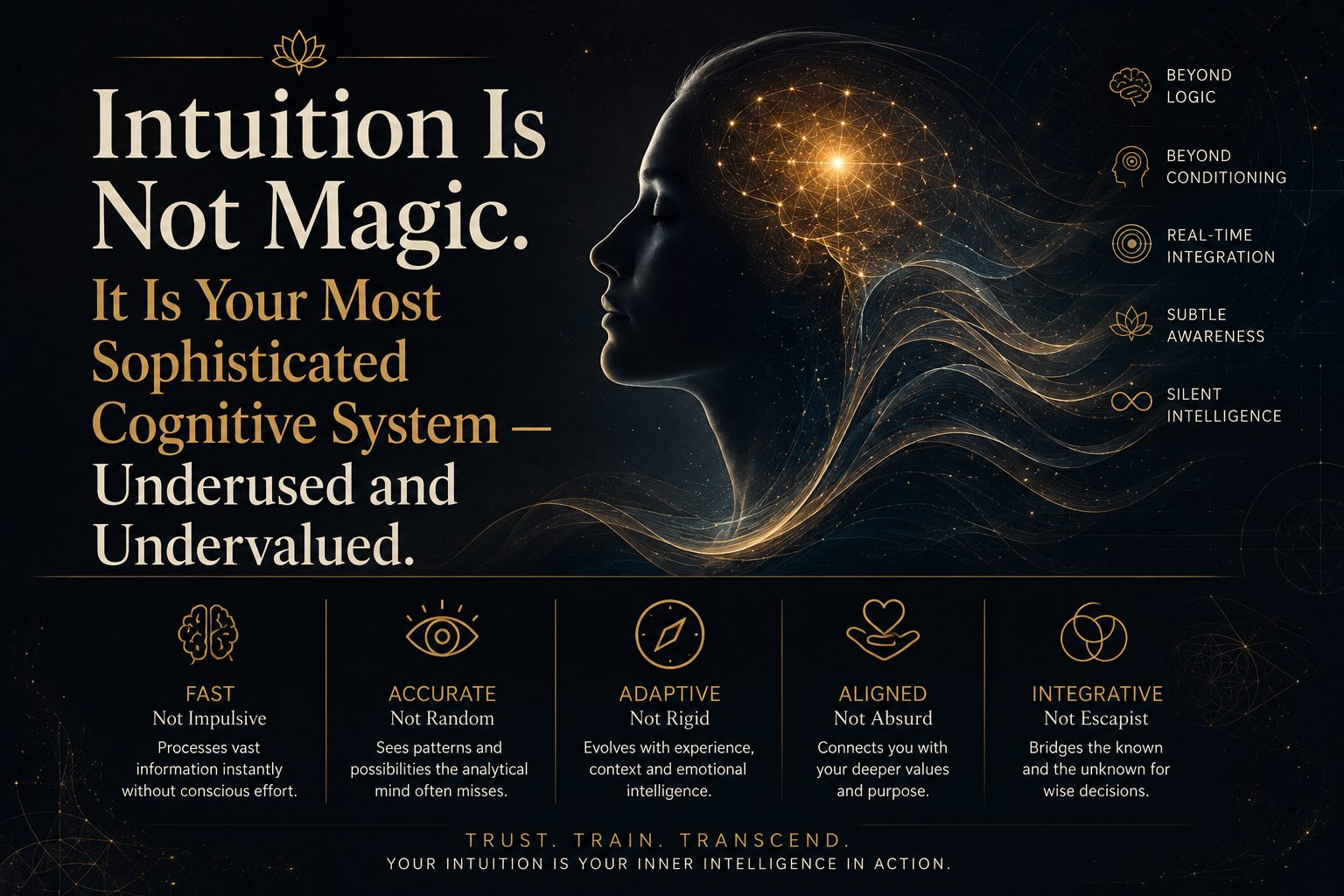
Intuition Is Not Magic. It Is Your Most Sophisticated Cognitive System — Underused and Undervalued.
The leaders who will define the next decade are not the ones with the best data. They are the ones who have learned to trust their own signal.
In every keynote I deliver to senior leaders, I ask the same question: When was the last time you made a significant decision based purely on intuition — and it was right?
Every hand in the room goes up. Every single time.
Then I ask: When was the last time you made a significant decision based purely on data analysis — and it was wrong?
Those hands go up too.
What this tells us is something that the data-driven culture of modern organisations is structurally resistant to acknowledging: that intuition is not the enemy of good decision-making. It is often its most reliable ally. And that the leaders who have learned to integrate data intelligence with inner intelligence — who can read a spreadsheet and read a room and read themselves simultaneously — are the leaders who make the decisions that actually matter.
Intuition is not mystical. It is the nervous system’s capacity to integrate thousands of data points — sensory, somatic, relational, experiential — below the threshold of conscious awareness, and to surface the result as a felt sense. A knowing. A pull. A clarity that arrives not through reasoning but through the body’s more immediate intelligence.
The Training of Intuition
Intuition can be trained. Not by thinking harder. By listening more finely. By developing, through practice, the capacity to distinguish between the voice of intuition (clear, quiet, consistent) and the voice of anxiety (loud, insistent, driven by fear) and the voice of desire (seductive, partial, serving a specific outcome).
This is exactly what Kathak trains. The practice of listening to the body’s signal with such precision that you can navigate through extraordinarily complex rhythmic and expressive material in real time, responding not from a plan but from a live, moment-to-moment attunement.
Transfer this to leadership — and to life — and you have something that no MBA programme teaches. Wellbeing Aacharya exists, in part, to teach exactly this: the integration of outer intelligence and inner intelligence into the kind of wholeness that makes genuine wisdom possible.