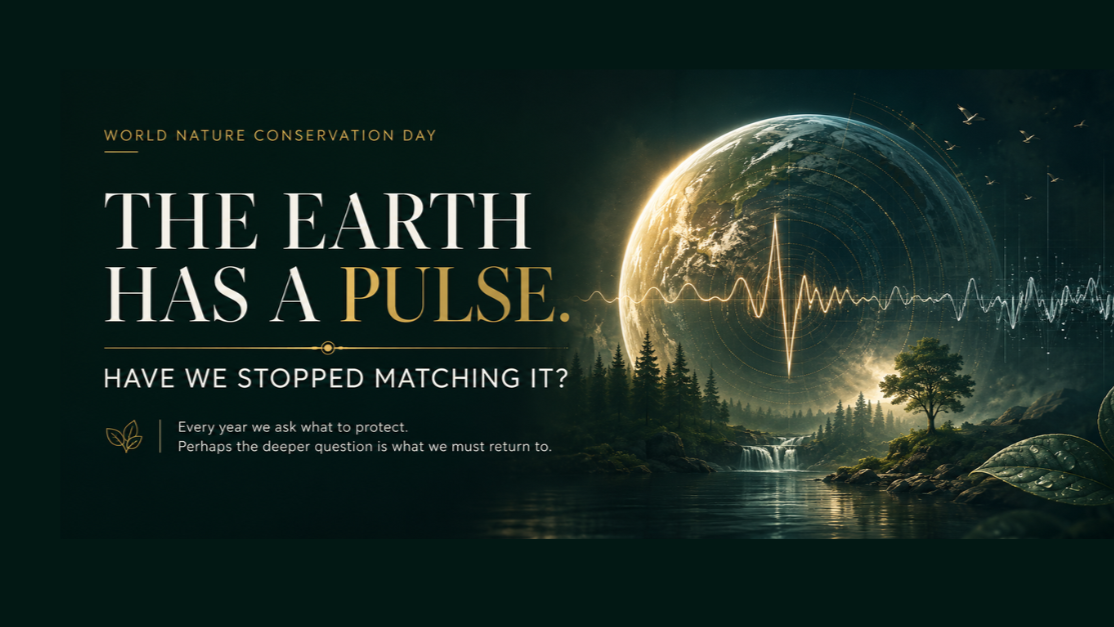
THE EARTH HAS A PULSE. WE STOPPEDMATCHING IT.
Let me tell you a story today. A story about nature, read through the lens of physics — and the invisible intelligence that holds all of life together.
Every natural system runs on rhythm.
Tides. Seasons. The circadian cycle. Breath. Heartbeat. Migration. Bloom. Decay. None of it runs on a schedule. It runs on a tempo — and every tempo is tuned to the ones around it. The bee to the flower. The flower to the light. The light to the tilt of the planet.
Physics has a word for what holds that together.
Entrainment.
Two oscillating systems, placed near each other, will synchronise. Put two pendulum clocks on the same wall, and within hours they begin to swing as one. Nobody touches them. The wall carries the information.
Every living system on this planet is entrained to every other one.
Except us.
Somewhere in the last two centuries we adopted a tempo with no relationship to the planet’s. The quarter. The deadline. The notification. The financial year. Not one of them corresponds to anything happening outside the window. We built an artificial oscillator, and then synchronised an entire species to it.
And here’s the consequence I don’t hear anyone discussing.
A body that has lost the earth’s tempo can no longer feel the earth’s distress.
It can only read about it.
This is why the data doesn’t always move us. Not for lack of caring — I think we care far more than we admit. But feeling requires resonance, and resonance requires two systems oscillating near enough to move each other.
We broke proximity.
We now run at a frequency the planet doesn’t share, and so its signal reaches us as information instead of sensation.
You already know the difference. Everyone does.
Think of the last time you read about a forest. You registered it. A fact, filed away, and gone by the next sentence.
Now think of the last time you stood inside one.
Your breath slowed. Your eyes softened. Your nervous system stopped defending itself for a moment. Something moved in you that you couldn’t quite name — and didn’t need to.
That wasn’t imagination.
That was entrainment. Your body found the tempo. It took only a few minutes. And it happened entirely without your permission.
So when we talk about conservation, I sometimes feel we’re talking about the symptom.
Conservation is what we do for something we’ve stopped being synchronised with. We protect it the way we protect a stranger — from principle, from a distance, with effort. And that matters. But it isn’t the deepest relationship a person can have with the living world.
Because what truly holds a system together isn’t only policy.
It’s rhythm. It’s proximity. It’s belonging.
And here is the uncomfortable thing I’ll say out loud.
We will not save what we are no longer in rhythm with.
Not for any shortage of intelligence, and not for any shortage of intention.
Because feeling is physics. And physics will not accept intention as a substitute for proximity.
The good news — and there is some — is that entrainment is fast. Sit beside moving water for twenty minutes, and something in your breathing changes on its own, unasked. The body remembers the tempo instantly. It never forgot. It was only drowned out.
So on World Nature Conservation Day, perhaps the question isn’t only what we must protect.
Perhaps the deeper question is what we must return to.
Because the earth doesn’t only need our concern.
It needs our rhythm back.
So here’s my question — and I’d genuinely love your answers.
When did you last do something at the earth’s tempo instead of your own?
Not a holiday. Not a photograph. Not content.
Something you did slowly, for the simple reason that the thing itself was slow.