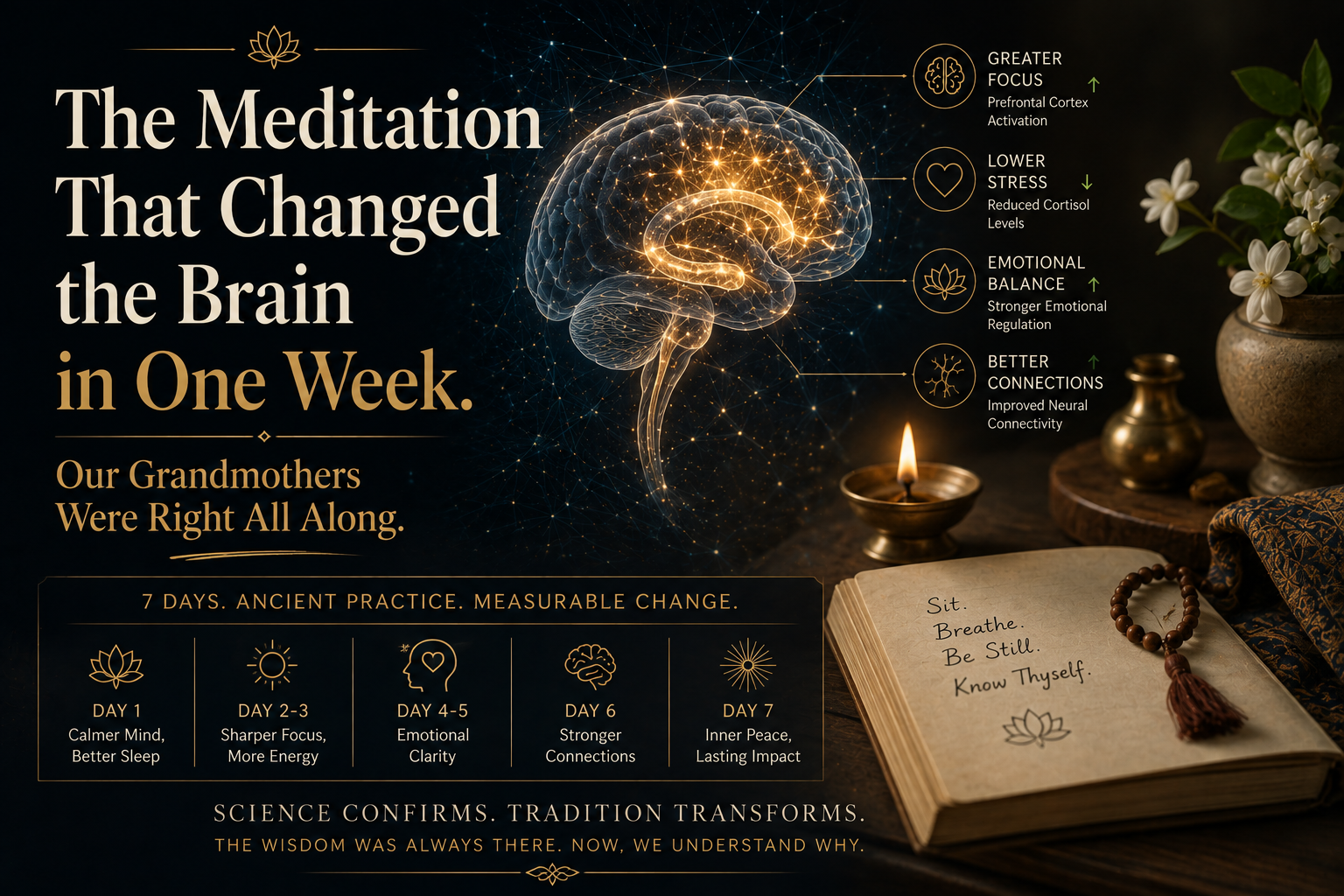
The Meditation That Changed the Brain in One Week. Our Grandmothers Were Right All Along.
Science took 5000 years to catch up with what practice already knew.
I read the MIT study with a very specific feeling. Not surprise. Not vindication — that would suggest I had been uncertain. The feeling was something more like: finally. Finally, the language that the modern world can hear has arrived to confirm what the practice has always known.
A week of intensive mind-body practice. Measurable changes in brain efficiency — the brain doing more with less effort. Boosted immune signalling — the body better able to defend and repair itself. Increased natural pain-relief chemistry — the body producing its own medicine. Seven days. Measurable. Documented. Peer-reviewed.
My grandmother would not have been surprised. The women who maintained daily sadhana — morning puja, pranayama, the recitation of Sanskrit shlokas — understood, in their bodies and in their lives, exactly what this study is describing. They had no language for neuroplasticity or immune modulation. But they had the results. They lived longer, calmer, more grounded, more resilient lives than the modernised generations that came after them and threw the practice away in exchange for convenience.
The deepest tragedy of modernity is not that we abandoned traditional practices. It is that we abandoned them without understanding what they were doing — and then spent a century reinventing them, badly, as “wellness.” Mindfulness is Dhyana. Breathwork is Pranayama. Forest bathing is Vanavasam. We renamed the medicine and forgot the pharmacopeia.
The Practice I Recommend
At Wellbeing Aacharya, the programme I offer is not a seven-day retreat, though intensive immersions are part of what I teach. It is a daily practice — sustainable, accessible, integrated into the rhythm of a real life. Fifteen minutes of conscious breath in the morning. A mindful awareness of the body throughout the day. A moment of genuine stillness before sleep.
This is not demanding. But it is transformative. Because the cumulative effect of returning, daily, to your own centre — of building, over months and years, the neural pathways of equanimity and presence — is exactly what the study described at the end of one intensive week. Multiplied across a lifetime, it is something else entirely.
It is, in the deepest sense, a life.