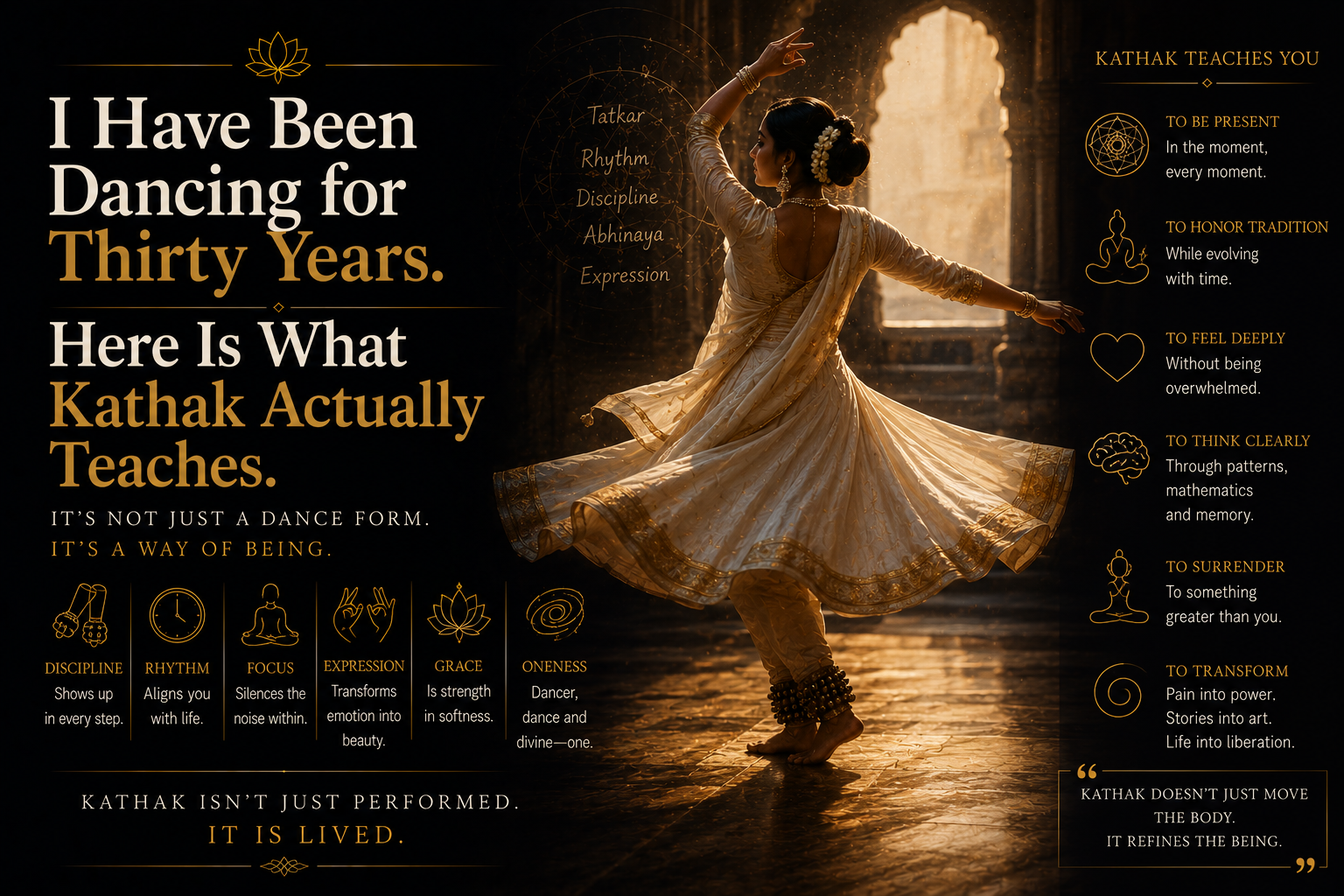
I Have Been Dancing for Thirty Years. Here Is What Kathak Actually Teaches.
It was never about the footwork. It was always about the freedom.
I began learning Kathak when I was three years old. I am still learning it today.
I say this not to impress you. I say it to tell you the truth about what Kathak is — not the art form on stage, not the competitive discipline in the studio, but the living practice that a serious student inhabits for a lifetime. It is not a skill you acquire. It is a relationship you enter. And like all deep relationships, it changes you in ways you did not anticipate and could not have prepared for.
Let me be precise about what I mean.
The Neuroscience of the Practice
When you learn Kathak — I mean seriously learn it, not perform for Instagram — you are simultaneously training your feet in complex rhythmic patterns, your hands in precise mudra geometry, your face in the full spectrum of Navarasas, your eyes in independent movement, and your entire inner landscape in the emotion required to animate all of this with authentic feeling. You are, in neurological terms, integrating left and right brain, body and mind, emotion and cognition, at a level of simultaneity that almost no other human activity achieves.
Research in developmental neuroscience now confirms what classical Indian pedagogy always knew: that embodied, multimodal learning creates the deepest and most lasting neural integration. That the arts, practiced with rigour and depth, are not recreational but developmental. They build the kind of whole-brain intelligence that no academic curriculum produces.
Kathak is not a dance form. Kathak is a philosophy with a body. Every step is a statement. Every pause is a question. Every performance is an inquiry into the nature of consciousness, offered through the most ancient medium available: the human body in motion.
What Thirty Years Taught Me
Discipline. Not the grim, self-punishing kind — but the liberating kind. The understanding that true freedom is not the absence of structure, but its complete mastery. That when the technique becomes so integrated it disappears, what remains is pure expression. That the gate to creativity is not the bypassing of rigour, but its transcendence through absolute commitment to it.
This is the knowledge I bring to every stage, every boardroom, every classroom. Through PATHFINDER™ — my Kathak-based early childhood development programme — I am taking this wisdom to children as young as three. Because the neural plasticity window is real, and the gift of this practice, given early, shapes a human being for life.
At Kala Saadhna, I train the next generation not just in the technique, but in the philosophy. Because Kathak without its philosophy is acrobatics. Beautiful, perhaps. But not transformative.