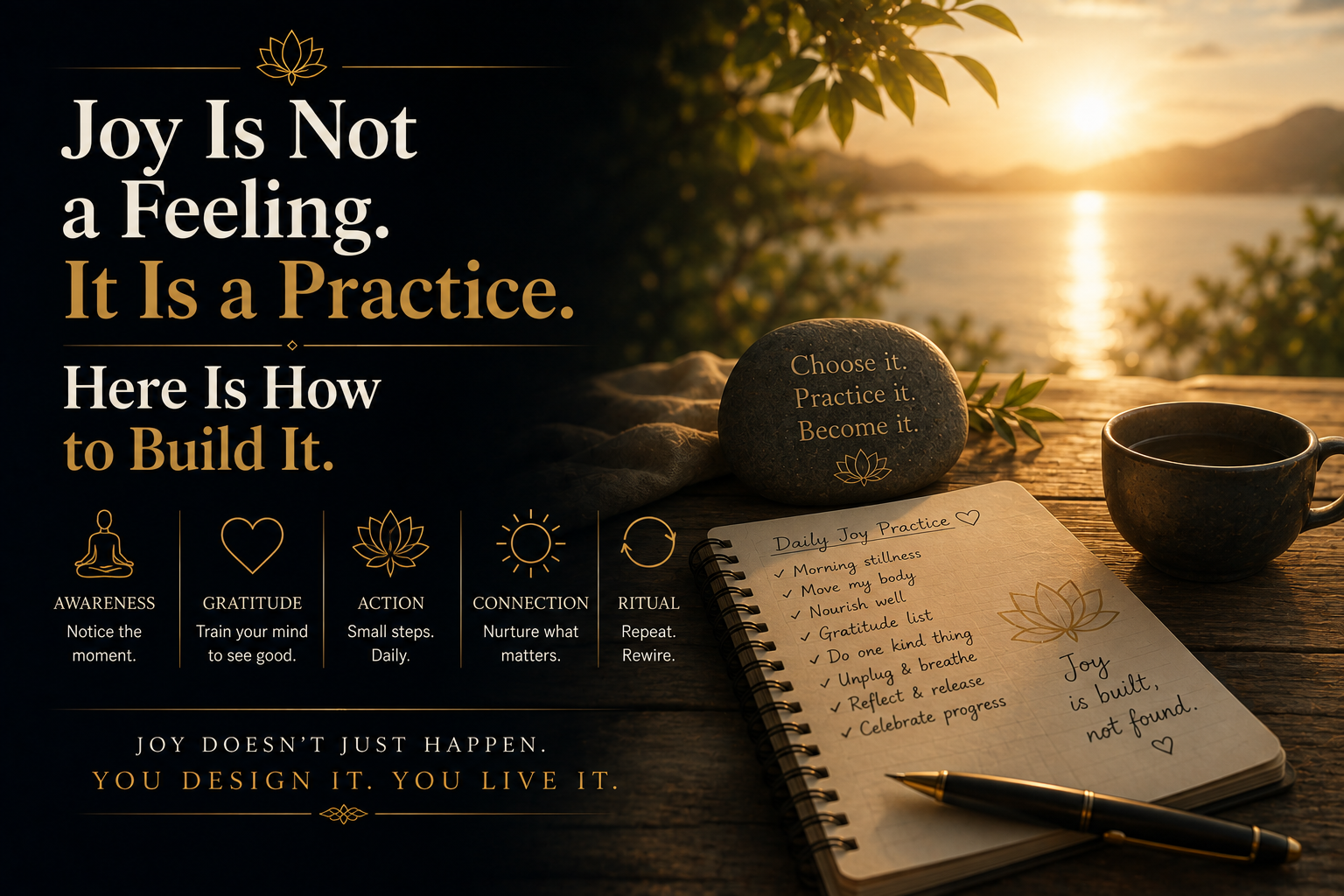
Joy Is Not a Feeling. It Is a Practice. Here Is How to Build It.
Happiness is what happens to you. Joy is what you construct, deliberately, from the inside out.
My 2026 contemplative fine-art calendar is called Quantum Happiness: Anatomy of Joy. When I chose that title, I was making a deliberate philosophical claim: that joy has an anatomy. That it is not random. Not luck. Not the product of the right circumstances or the right chemicals. That it is a structure — something that can be understood, cultivated, and inhabited.
Fifteen years of producing these annual calendars have been, for me, a practice of this very inquiry. What is the architecture of a joyful human life? Not a comfortable life. Not a successful life. Not a life devoid of suffering — that is neither possible nor desirable. But a life that is infused, at its structural level, with the quality of aliveness that I recognise, when I encounter it, as joy.
Here is what I have found.
The Four Pillars of the Architecture of Joy
The first pillar is Presence. Joy is always available in the present moment. Always. Not because the present moment is always pleasant — it frequently is not. But because the capacity to be fully in one’s experience — without the overlay of past regret or future anxiety — is the precondition for joy of any kind. The practice of presence is the foundation of everything.
The second pillar is Meaning. Human beings are meaning-making organisms. When we cannot find meaning in our lives — in our work, our relationships, our suffering — we wither. Not from lack of comfort, but from lack of significance. The cultivation of meaning is not passive. It is an active creative choice to orient one’s life around what is genuinely, personally, irreducibly important.
The third pillar is Beauty. Not aesthetics — not the mere appreciation of pleasing forms — but the practice of genuinely encountering the beautiful in the world, in the body, in other people, in the natural world, in art, in mathematics, in the unexpectedly sublime. Beauty is not decoration. It is oxygen for the soul.
The fourth pillar is Connection — genuine, reciprocal, risky, transformative connection with other human beings. Not networking. Not social media. The kind of connection in which you are truly seen and truly see another — and both parties are changed by the encounter.
These four pillars are not aspirational. They are structural. They require practice. They require courage. And they produce, over time, the only kind of joy worth having: the kind that does not depend on your circumstances.