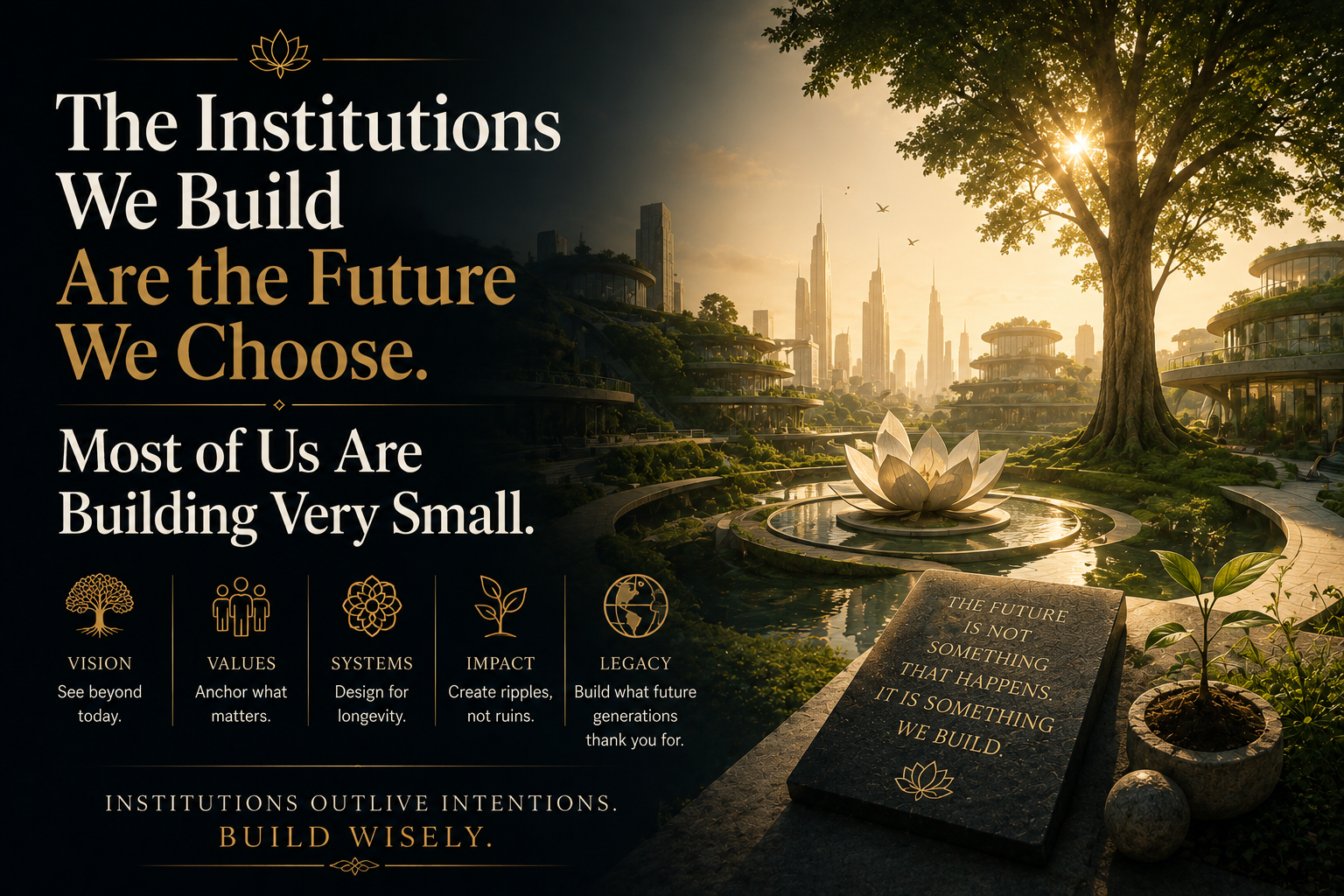
The Institutions We Build Are the Future We Choose. Most of Us Are Building Very Small.
A civilization is not built by its governments. It is built by its institution-builders — the people who create the structures within which human beings can flourish.
I want to talk about the courage it takes to build something that is meant to outlast you.
Not a career. Not a brand. Not even a movement — though movements matter. I want to talk about institutions: the structures, the organisations, the schools, the practices, the lineages — the architectures within which human beings learn to be excellent, to be connected, to be free.
Kala Saadhna. Wellbeing Aacharya. The Shivaakriti Foundation. I AM by Aparna Mishra. These are not businesses. They are bets on the future. Each one embodies a particular conviction about what matters, and makes that conviction structural — gives it walls, curriculum, community, and continuity beyond the life of any single individual.
This is extraordinarily difficult work. Not the practical difficulty — though that is real enough. The philosophical difficulty. The difficulty of being willing to be misunderstood for long enough that the institution can prove itself. Of holding vision against the constant pressure to compromise, to scale faster than wisdom permits, to trade depth for reach.
Every institution that has shaped human civilisation began as an act of audacious clarity. One person — sometimes a few — who understood something with sufficient precision that they were willing to build a structure around it and stake their life on its value. The Nalanda University. The Kathak Kendra. The Bauhaus. Every institution is, at root, a manifesto made physical.
What I Know About Building
Build slower than you want to. The foundation is everything. An institution built on the rush of early enthusiasm collapses when the enthusiasm fades — and it always fades, at least for a season. An institution built on deep conviction, clear purpose, and unhurried structural integrity endures.
Know the difference between what you are building and who you are. The institution is not you. It will survive you. That is the point. Your job is to build it with enough integrity that it can survive your absence, your evolution, your mistakes. This requires a generosity of spirit — a willingness to create something that belongs not to you, but to the tradition and the people it serves.
And finally: build for the person who needs it most, not for the largest possible audience. The most enduring institutions are not the broadest. They are the deepest. They serve fewer people more completely. That is how they last.