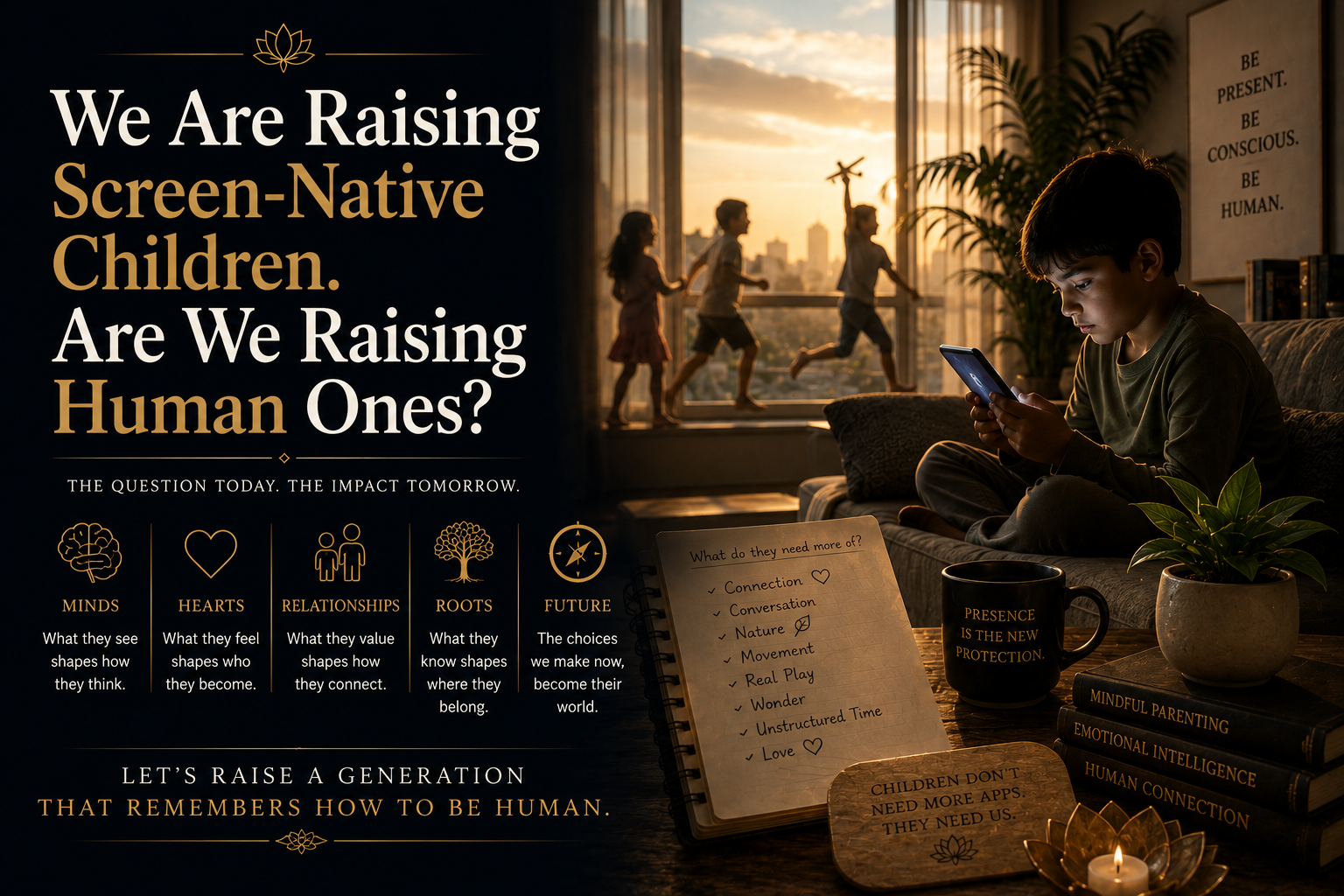
We Are Raising Screen-Native Children. Are We Raising Human Ones?
The greatest threat to childhood is not screen time. It is the absence of embodied experience.
I want to start with what I know from watching children.
I have been teaching children for thirty years. Children at three years old, children at thirteen, children who have been brought to me by parents who are quietly, desperately worried. And what I observe, consistently, over the past decade — with increasing urgency — is this: children are becoming more connected and less embodied. More stimulated and less grounded. More knowledgeable and less wise.
They know things. They do not know themselves.
The research confirms what every attentive teacher and parent already senses. Neuroscience tells us that children develop empathy primarily through face-to-face interaction — the reading of micro-expressions, tone, body language. They develop executive function through unstructured physical play. They develop creativity through boredom. They develop emotional resilience through navigating real, non-virtual challenges. They develop identity through the embodied experience of doing something difficult, repeatedly, over time, and watching themselves become capable.
The question is not whether to allow screens. The question is whether we are providing sufficient counterweight: sufficient experience of embodiment, of nature, of genuine difficulty, of the kind of deep, sustained, face-to-face community that was once simply called growing up.
PATHFINDER™: The Answer I Built
PATHFINDER™ — my Kathak-based early childhood development programme for children aged three to six — was created because I believe that the most powerful gift we can give a child in the digital age is a profound and joyful relationship with their own body. With rhythm. With expression. With the ancient intelligence of classical art.
In PATHFINDER™, children learn Kathak not as performance preparation, but as developmental practice. They develop coordination, concentration, emotional vocabulary, and creative expression. They learn to be in a room together, to witness each other, to take turns, to inhabit their own experience with attention and delight. These are not incidental outcomes. They are the most important things a three-year-old can learn.
The world they are growing into will need them to be fully human. Let us give them the practice for it.