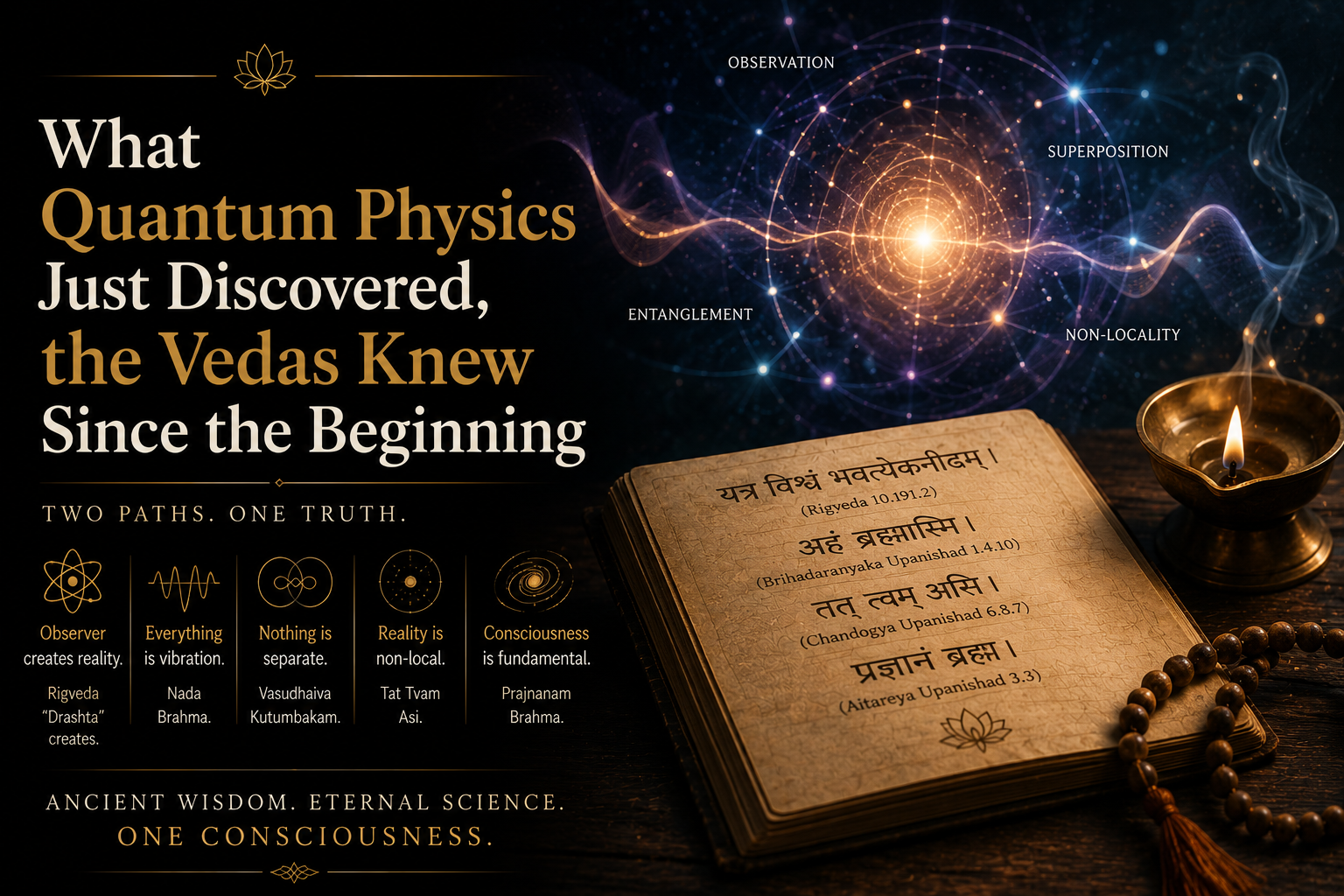
What Quantum Physics Just Discovered, the Vedas Knew Since the Beginning
Consciousness is not a product of matter. Matter is a product of consciousness. Welcome to 2026 — and to a conversation that began in 3000 BCE.
In February 2026, scientists at MIT announced a new tool for investigating consciousness. In April 2026, researchers published a paper asking whether consciousness is produced by the brain or woven into the fabric of reality itself. In the same month, leading physicists declared that “existential risk” arises from our advancing AI without understanding what consciousness is.
Welcome to the frontier of modern science. It is a frontier that the Upanishads mapped five thousand years ago.
This is not mysticism. This is epistemology. The Vedantic understanding — that consciousness (Chit) is not an emergent property of matter but the ground from which both matter and mind arise — is precisely what quantum mechanics has been suggesting since Heisenberg. The observer effect. Entanglement. Non-locality. The collapse of the wave function through observation. These are not metaphors for consciousness. They are evidence of it.
Quantum mechanics ends where Vedanta begins. Both arrive at the same destination: that the universe is not a collection of objects. It is a web of relationships, permeated by a consciousness that is not located inside heads but is the ground from which all heads — and all objects — emerge.
My Calendar as Inquiry
This is the philosophical terrain of my 2026 contemplative fine-art calendar: Quantum Happiness — Anatomy of Joy. Fifteen years of producing these annual calendars have been a journey through exactly this territory: the meeting point of Vedic cosmology and modern science, rendered not in academic prose but in the language of art, poetry, and Kathak philosophy.
The calendar is not a product. It is a practice. Each month is an invitation to a different mode of knowing — through the body, through the senses, through the silence between thoughts, through the quantum uncertainty that lives at the heart of every decision, every relationship, every creative act.
Practical Vedanta
At Wellbeing Aacharya, I bring this not as philosophy for the intellectually curious, but as practice for the practically overwhelmed. Because the moment you truly understand — not just intellectually but experientially — that you are consciousness having an experience, rather than a problem-solving brain trapped in a body, everything changes. Your relationship to stress changes. Your relationship to failure changes. Your relationship to other people changes. Your entire experience of what it means to be alive changes.
This is the transformation that is possible. And it begins with the willingness to take the ancient seriously.